DTF Transfers for Embroidery Shops
DTF transfers for embroidery shops add vibrant, full-color apparel decoration without requiring a second in-house print department. Expand your services, accept more artwork styles, and keep production flexible.
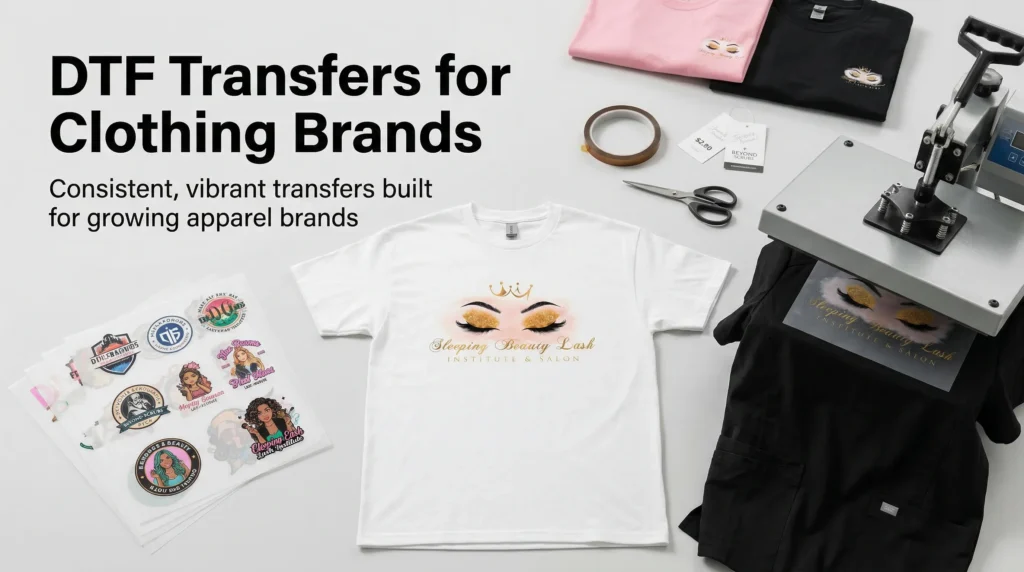
Embroidery remains one of the best choices for dimensional logos, uniforms, hats, polos, jackets, and premium corporate apparel. But not every customer design is suitable for thread. Detailed illustrations, gradients, photographs, tiny color changes, and short promotional runs can be difficult or expensive to reproduce with embroidery alone.
DTF transfers for embroidery shops solve that service gap. Your shop can continue offering embroidery while using ready-to-press transfers for artwork that benefits from smooth color, sharp detail, and flexible quantities.
Why DTF Transfers for Embroidery Shops Make Sense
Adding a new decoration method does not have to mean purchasing, maintaining, and operating a complete DTF print line. Outsourcing transfer manufacturing allows an embroidery business to use its existing heat press, apparel knowledge, customer relationships, and fulfillment workflow.
1. Accept Designs That Thread Cannot Reproduce Easily
Embroidery has texture and dimension, but every stitch has physical limits. Highly detailed artwork may require simplification, and large filled areas can become heavy or expensive. Full-color transfer printing gives shops another option for complex designs without forcing the customer into an unsuitable stitch file.
Photographic elements, distressed textures, gradients, and numerous small color changes can be produced as a single transfer. This is useful for spirit wear, event merchandise, creator apparel, fashion graphics, and customer artwork designed primarily for digital printing.
2. DTF Transfers for Embroidery Shops With Small Orders
Customers increasingly request small batches. A business may need five event shirts, a creator may want to test one design, or an existing client may need a single replacement garment. Flexible transfer ordering helps the shop serve those requests without creating a large inventory commitment.
Once a design proves successful, the same production method can support a larger order. Shops can test demand, approve placement and color on a sample garment, then scale with greater confidence.
3. Build Mixed Decoration Packages
DTF does not need to replace embroidery. The two methods can work together within one customer program. A company may choose an embroidered chest logo on polos and jackets while using a full-color transfer on event shirts, employee gifts, or promotional totes.
- Embroidered caps paired with printed event shirts
- Stitched uniform logos with full-color back graphics
- Premium embroidered outerwear plus affordable promotional apparel
- Thread-based branding combined with printed names, numbers, or campaign artwork
This approach gives clients a consistent supplier while allowing the shop to recommend the best decoration method for each garment and design.
4. Use Gang Sheets to Organize Production
A gang sheet combines several graphics on one larger print area. Embroidery businesses can place chest designs, full backs, sleeve marks, neck labels, and repeat copies together. Careful planning reduces unused space and keeps related customer work organized.
Use the online gang sheet builder to arrange artwork, or upload a completed gang sheet when your team already has a print-ready layout.
5. Prepare Artwork for Reliable Results
Good output begins with a good source file. Vector artwork works well for logos and clean line art. Transparent PNG artwork is practical for detailed raster designs when it is prepared at the exact print size and sufficient resolution.
- Set raster artwork to 300 DPI at the intended print dimensions.
- Remove unintended backgrounds and transparent padding.
- Confirm spelling, colors, quantities, dimensions, and orientation.
- Keep critical details away from rough or semi-transparent edges.
- Test the first garment before pressing an entire production run.
For technical context about resolution, consult Adobe’s image size and resolution guide. SpeedE Transfers also provides current DTF artwork requirements.
6. Press DTF Transfers Consistently
A heat press must provide controlled temperature, time, and pressure. When applying DTF transfers for embroidery shops, use the current instructions supplied for the transfer, verify the press temperature, prepare the garment, and keep the application surface flat. Fabrics and garment coatings can vary, so test unfamiliar blanks before production.
Placement templates and written production notes help multiple team members achieve repeatable results. Record the garment style, transfer dimensions, placement measurements, press settings, peel method, and finishing steps for recurring orders.
7. Scale DTF Transfers for Embroidery Shops
A shop can begin with occasional outsourced transfers and expand as demand becomes clear. Store transfers separately from blank garments, press according to actual sales, and keep approved artwork ready for repeat orders. This reduces finished inventory while supporting faster fulfillment.
For growing volume, the wholesale DTF program provides a path for embroidery businesses, apparel decorators, and print shops with larger or recurring requirements.
DTF Transfers for Embroidery Shops FAQ
Do I need to own a DTF printer?
No. DTF transfers for embroidery shops can be outsourced as ready-to-press graphics and applied with a compatible heat press.
Can I combine embroidery and DTF on one order?
Yes. Many programs use embroidery for polos, jackets, or hats and transfers for detailed shirts, bags, or promotional garments.
What artwork should customers provide?
Vector files are ideal for many logos. Transparent, high-resolution PNG files are also suitable when prepared at final print size.
Can DTF support repeat customer jobs?
Yes. Save approved artwork, dimensions, placement notes, and production settings to create a more repeatable workflow.
Which garments can be decorated?
DTF can work with cotton, polyester, blends, and many other compatible materials. Test the exact blank for heat sensitivity, dye migration, coatings, texture, and adhesion.
Start Offering DTF Transfers for Embroidery Shops
Adding ready-to-press transfer production gives your embroidery business another way to solve customer problems. Accept more artwork styles, offer mixed decoration packages, fulfill short runs, and scale production without building an in-house DTF department.
Expand Your Decoration Services
Choose DTF transfers for embroidery shops that fit your workflow, then receive professional graphics ready for your heat press.
Build a Gang Sheet Upload a Gang Sheet Contact SpeedE Transfers