
DTF Transfer Service: 7 Proven Ways to Choose the Best
A DTF transfer service should deliver more than attractive sample photos. Compare print quality, adhesion, repeatability, turnaround, pricing, artwork support, and clear application instructions before trusting a provider with customer orders.
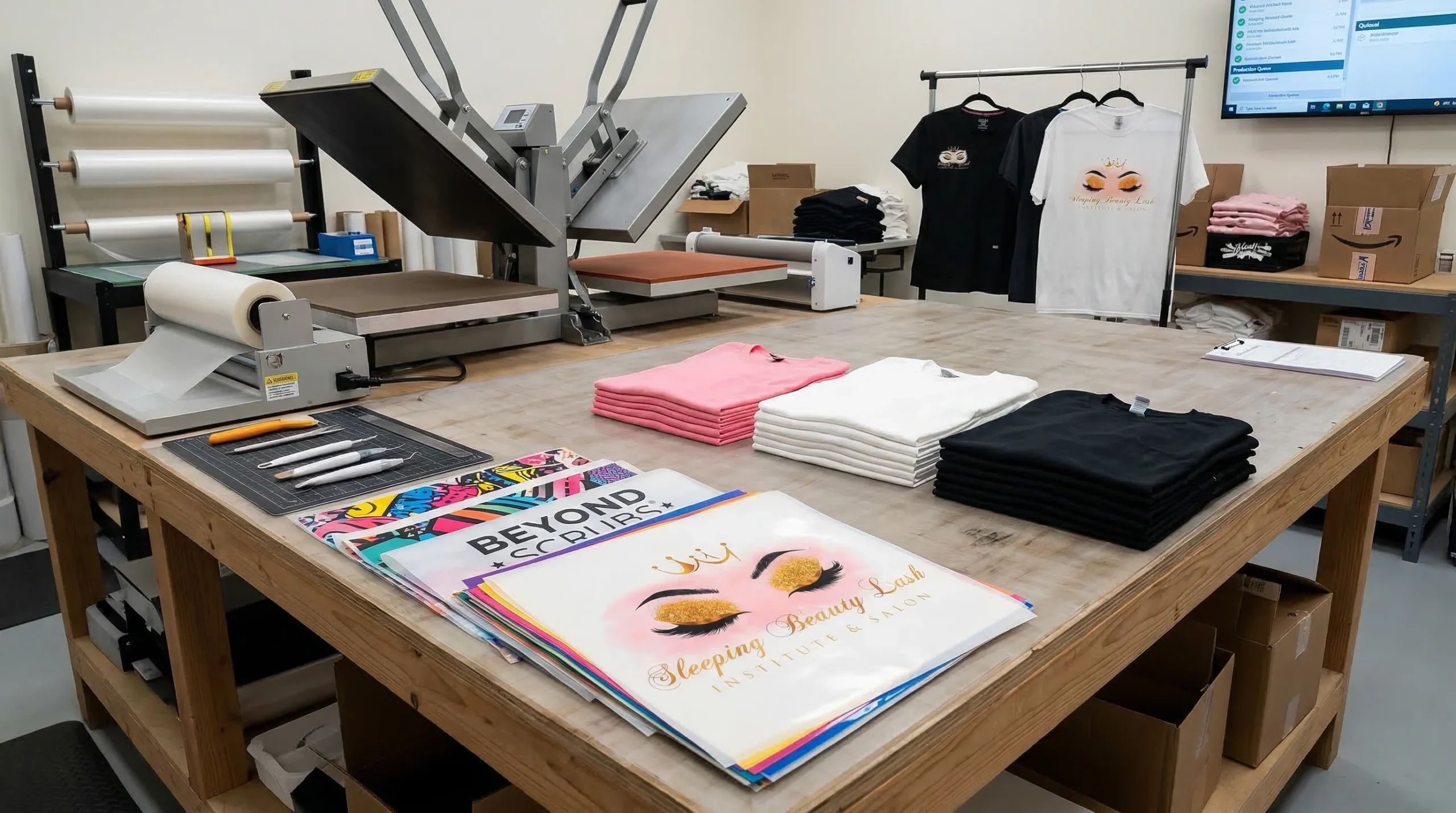
Choosing the right provider protects garments, production time, and your reputation. A professional DTF transfer service combines suitable ink, film, adhesive, curing controls, color management, artwork preparation, and responsive support. Weakness in any one of those areas can lead to dull color, rough edges, poor release, peeling, or inconsistent repeat orders.
This guide turns broad marketing promises into seven practical checks. Use them to compare physical samples and business terms before placing a large order.
What Does a DTF Transfer Service Do?
Direct-to-Film production prints artwork in reverse on PET film using compatible color and white inks. An adhesive powder is applied and cured, creating a ready-to-press transfer. The decorator positions the transfer on a suitable garment and applies it with controlled heat, time, and pressure.
Because printing happens on film rather than directly on the garment, DTF can support detailed multicolor artwork on cotton, polyester, blends, and many other compatible fabrics. Exact performance depends on the transfer, application, garment construction, dyes, coatings, and care.
1. Inspect DTF Transfer Service Print Quality
Print quality determines whether artwork looks clean on the finished garment. Ask for close-up photographs and a physical sample that includes small lettering, fine lines, gradients, saturated colors, and an opaque white underbase on a dark fabric.
- Edge definition: Look for crisp contours without halos or excessive adhesive.
- White opacity: Inspect whether dark fabric changes the intended colors.
- Color transitions: Check gradients for banding or visible dot patterns.
- Surface finish: Evaluate consistency, flexibility, and unwanted residue.
- Fine details: Confirm that small text and thin elements remain usable.
Do not judge from a heavily compressed social-media image alone. A physical sample reveals release behavior, thickness, texture, and opacity more accurately.
2. Test Adhesion and Washability
Durability depends on transfer production and correct application. Request the provider’s instructions, press a sample onto the same blank planned for production, and inspect it after cooling. Stretch the garment gently and examine the edges for lifting or cracking.
Run a documented wash test using the care instructions you intend to give customers. Record the garment, application settings, wash method, drying method, and number of cycles. This makes comparisons repeatable instead of relying on memory.
3. Request Meaningful Samples
A useful sample should help you test the actual DTF transfer service production process. Ask whether it represents current ink, film, powder, curing, and release behavior. If your artwork uses tiny type, heavy white ink, transparency, or unusual color, order a proof using the real file before committing to volume.
A reliable DTF transfer service should explain what the sample demonstrates and which garments or settings were used. Samples are especially valuable when changing providers, introducing a new blank, or preparing an important product launch.
4. Evaluate Repeat-Order Consistency
One excellent sample does not guarantee consistent production. Ask how the provider manages artwork versions, dimensions, color references, equipment calibration, and quality checks. Repeat orders should use the approved file and maintain stable sizing and visual character.
Save your own production record containing the final artwork, ordered dimensions, garment style, placement, press settings, peel method, and approval notes. These details help your DTF transfer service investigate differences quickly if a later batch changes.
5. Compare Turnaround, Pricing, and Support
The lowest DTF transfer service unit price is not always the lowest total cost. Include setup requirements, minimums, sample costs, gang sheet options, rush fees, shipping, reprints, damaged garments, and the time required to resolve problems.
| Factor | Positive indicator | Question to ask |
|---|---|---|
| Turnaround | Clear production cutoff and realistic estimates | When does production begin, and is shipping time separate? |
| Pricing | Transparent product and quantity options | Are there gang sheet, volume, sample, or rush charges? |
| Support | Responsive, specific answers | Who handles artwork and production questions? |
| Problems | Published claim or reprint process | What evidence is required for a production issue? |
For urgent work, reliability may matter more than the smallest price difference. For planned volume, efficient gang sheets and clear quantity pricing may have greater value.
6. Review Artwork and Gang Sheet Support
Artwork should be prepared at final print size. Vector formats are strong choices for logos and line art, while transparent high-resolution PNG files work well for detailed raster designs. Always follow the provider’s current file requirements.
- Confirm final width and height for every graphic.
- Use 300 DPI at final size for raster artwork.
- Remove unwanted backgrounds and transparent padding.
- Check spelling, orientation, quantities, and artwork versions.
- Keep a copy of the submitted file and order confirmation.
For technical background, review Adobe’s image size and resolution guidance. SpeedE Transfers also provides current DTF artwork requirements and an online gang sheet builder.
7. Confirm DTF Transfer Service Application Guidance
Clear instructions reduce application failure. A provider should identify the recommended temperature, dwell time, pressure, peel method, and finishing press for the specific transfer. Garment variables still matter, so test unfamiliar fabrics, coatings, dyes, and textures.
SpeedE Transfers maintains current heat-press instructions. Confirm that your press reaches the displayed temperature accurately and applies even pressure across the platen.
How DTF Compares With Other Printing Methods
DTF is useful for detailed, multicolor designs and mixed-fabric short or medium runs. Screen printing can become economical for large quantities of simple spot-color artwork but requires screens and setup for each color. Sublimation provides a very soft result on suitable polyester products but cannot produce opaque white on dark cotton garments.
The right choice depends on design complexity, quantity, fabric, desired feel, available equipment, deadline, and budget. A responsible provider should explain where DTF fits rather than treating it as the only solution.
DTF Transfer Service Evaluation Checklist
Use this DTF transfer service checklist before approving a provider for customer work or a critical product launch.
- Inspect a current physical sample on a relevant garment.
- Confirm opacity, edge clarity, flexibility, and release behavior.
- Run and document application and wash tests.
- Compare total cost, not only the advertised unit price.
- Verify production timing separately from carrier transit.
- Review artwork rules, approval steps, and issue resolution.
- Place a controlled trial order before moving critical volume.
DTF Transfer Service Frequently Asked Questions
What file format should I provide?
Follow the provider’s requirements. Transparent PNG at 300 DPI and final size is common for raster artwork; vector formats are useful for scalable logos and line art.
How should I compare two providers?
Send comparable artwork, use the same garment, follow each provider’s instructions, and document print appearance, application, wash results, turnaround, price, and support.
Are gang sheets more economical?
They can reduce cost when several designs or repeat copies use the print area efficiently. Poor spacing and unused film reduce that advantage.
Should I rely on generic heat settings?
No. Use the current product-specific instructions supplied by the transfer manufacturer and test the exact garment before a full run.
What is the safest first order?
Start with a sample or small trial using representative artwork and garments. Approve the complete result before ordering critical volume.
Test SpeedE Transfers for Your Next Project
Prepare your artwork, choose an ordering method, and evaluate the completed transfers using the seven checks above.
Build a Gang Sheet Upload a Gang Sheet Contact SpeedE Transfers