
If you’ve ever sat over a light box at 2:00 AM, squinting through a pair of tweezers while picking tiny pieces of plastic out of a detailed logo, you know the “HTV Nightmare.” You aren’t printing; you’re performing manual labor. At SpeedE Transfers, we reached a breaking point years ago. We realized that weeding is a tax on your time—and DTF transfers are the ultimate refund.
But what exactly is this technology that is currently dismantling the old-school foundations of screen printing and DTG? Why are shops across the country mothballing their carousels in favor of film? This isn’t just a “new way to print.” It is a fundamental shift in how we think about apparel decoration, durability, and business scalability.
The Anatomy of a DTF Transfers: How It Actually Works
To understand the process, you have to look past the hobbyist “converted” printers that often flood social media. At SpeedE Transfers, our process is built on industrial-grade reliability. This is a multi-stage method that combines digital precision with chemical bonding.
The Digital Layer: Industrial Precision
It starts with a specialized PET (Polyethylene Terephthalate) film. This isn’t your standard transparency; it’s treated with a unique coating that allows the ink to sit on the surface without “beading” or running, while still allowing for a clean release during the heat press stage.
We utilize a Production Stack anchored by dual-head industrial units, specifically featuring Epson i3200-A1 print heads.
- Head 1 (CMYK): This head is dedicated entirely to the color gamut. It provides the photographic 1440+ DPI resolution that gives our finished products their signature crispness.
- Head 2 (White): This is the secret to opacity. While the color is being laid down, this second head simultaneously prints a surgical-strike white underbase. This “wet-on-wet” printing ensures perfect registration—no more “white peeking out” from the edges of your design.
The Chemical Layer: The TPU Bond
Once the film leaves the printer, the ink is still wet. It immediately enters an Automatic Powder Management System. Here, a specialized TPU (Thermoplastic Polyurethane) adhesive powder is applied.
This powder only sticks to the wet ink. A high-frequency shaker then removes the excess (preventing “speckling” on the final garment). Finally, the film passes through a multi-zone infrared heating tunnel. This “gels” the powder, turning it from a dry dust into a durable, flexible adhesive layer that is chemically bonded to the ink, creating high-quality DTF transfers.
The “Why”: Why This is the Winner for Modern Apparel
In our experience, if we had to crown a #1 reason to switch, it would be unmatched versatility across fabrics.
The Limitation of the “Old Guard”
For decades, we were limited by the chemistry of our tools:
- Screen Printing: It’s the king of longevity, but it’s a nightmare on synthetics without expensive additives and low-bleed inks.
- DTG (Direct-to-Garment): This is almost strictly a “100% Cotton Club.” If you try it on polyester, the colors often “bleed” or look dull and sunken.
- Sublimation: Incredible for 100% white polyester, but completely invisible on dark fabrics or cotton.
The SpeedE Advantage
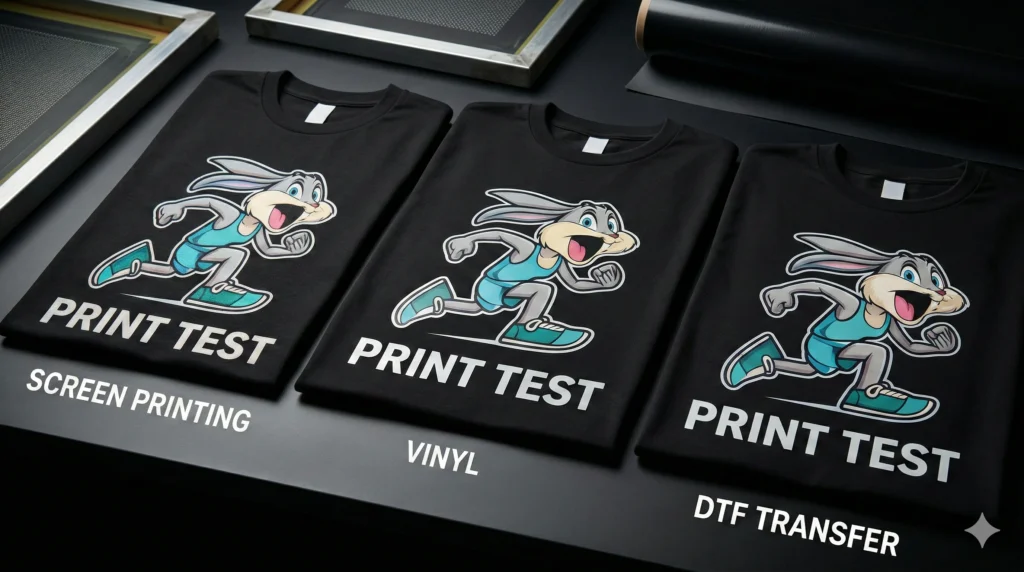
At SpeedE Transfers, we see customers switching because they no longer have to turn away jobs. Whether it’s nylon, spandex, 100% polyester, or even non-textiles like leather and wood, our DTF transfers bond perfectly. If you are printing activewear or performance gear that needs to stretch, this is the only logical choice.
Color Vibrancy (The “Pop” Factor): Because of that high-quality white underbase, a bright yellow logo on a pitch-black hoodie stays true. It doesn’t “sink” into the fabric like DTG; it sits on top of the fibers with a crisp finish that rivals the best screen prints.
Case Study: The “Mission Impossible” Save
We live for the moments where a shop owner calls us sounding completely defeated. The most memorable “Save” in SpeedE history involved a marketing agency that had already purchased 500 premium, water-resistant 100% Nylon hooded windbreakers.
The Challenge:
The nylon was treated with a DWR (Durable Water Repellent) coating.
- Screen Printing failed because the ink wouldn’t “bite”—it could be scratched off with a fingernail.
- Embroidery was impossible because the design was too dense, and the needle penetrations would have ruined the waterproof integrity of the thin material.
The SpeedE Solution:
When they reached out, they were 48 hours from their shipping deadline. We told them: “Send us the art. We’ve got this.”
Because our production process uses that specialized TPU powder, it acts like a high-strength flexible glue. While standard inks bead up on water-resistant coatings, our adhesive “locks” onto the fibers when heat-pressed at the correct pressure. We coached them on a specific “low-temp, high-pressure” technique (275°F for 12 seconds) to ensure they didn’t melt the delicate nylon.
By the next morning, the DTF transfers were at their shop. They pressed all 500 jackets in one day. Not only did the logos look photographic, but they passed the “stretch test” without a single crack. They didn’t just fulfill the order; they looked like heroes.
Durability: The “Texas Summer” Torture Test
The biggest concern people have with digital decoration is: “Will it peel after three washes?”
At SpeedE Transfers, we don’t just take the manufacturer’s word for it—we run what we call the “Industrial Grind.” Our best evidence didn’t happen in a lab; it happened with a local landscaping and hardscape crew in the 100°F+ Texas heat.
The Exposure:
We provided safety-orange moisture-wicking polyester shirts. These were soaked in sweat, covered in stone dust, and exposed to direct UV rays for 12 hours a day, 6 days a week.
The Wash Cycle:
The crew wasn’t following “delicate” instructions. They used heavy-duty industrial cycles, hot water, and high-heat drying to get the mud out.
The Result:
After three months (roughly 40+ aggressive cycles), the neon orange fabric of the shirts actually started to fray at the seams—but the DTF transfers stayed perfectly intact. The white underbase didn’t crack, and there was zero dye migration. The shirt literally started to fall apart before the print did.
The “Secret Sauce”: The SpeedE Professional Workflow
If there is one thing that separates a DIY look from a professional retail-grade finish, it’s the “Second Press” (The Finishing Press). Most beginners think the job is done once the film is peeled. From our POV, that is only 90% of the process.
Pro-Tip: The Texturizing Second Press
After you peel the carrier sheet, the design often has a slightly “plastic-like” or shiny finish. To truly lock the design into the fibers and give it a premium feel, you must do a second press.
- The Cover: Don’t just use a Teflon sheet. For a professional matte finish that mimics screen printing, use a piece of parchment paper or a textured silicone finishing sheet.
- The Action: Press the garment again for 5 to 8 seconds at 260°F.
- The Result: This second hit of heat and pressure drives the ink deeper into the “valleys” of the fabric weave. It removes the artificial shine and gives the print a much softer “hand feel” that moves with the person wearing it.
Two More “SpeedE” DTF Transfers Hacks:
- The “Pressure” Pitfall: Digital film is not like HTV. You need Firm to Heavy pressure. If you can easily close your heat press with one finger, it’s too light. You want the adhesive to “bite” into the fabric.
- The “Moisture” Move: If you are pressing on 100% cotton, always do a 5-second pre-press without the design. If there is steam trapped in the fabric when you lay your DTF transfers down, it can create tiny bubbles in the adhesive, leading to premature peeling.
The Business Math: Why Your Wallet Loves Digital Film
When we talk to skeptical small business owners, we lead with math. Most shop owners are so used to the “hidden costs” of their current methods that they don’t realize how much money they are leaving on the floor.
The “Death of Setup” Cost
In screen printing, your ROI (Return on Investment) is killed by the “Screen Tax.” For a 5-color logo, you spend 1–2 hours burning screens, taping, and registering. If the customer only wants 24 shirts, you’ve spent $50+ in labor and materials before you even pull a squeegee.
With SpeedE Transfers, there are zero screens. Whether it’s 1 color or 100, the “setup” is just dragging a file onto a Gang Sheet. You can say “Yes” to small-batch, high-color orders that your competitors have to turn away.
Labor-to-Leisure Ratio
If you are coming from HTV, look at the weeding comparison. If it takes 5 minutes to weed a complex logo, and you have an order of 50, that is 4 hours of manual labor. You can press those same 50 shirts with DTF transfers in 45 minutes. You just bought back 3 hours of your life.
ROI Comparison Table
| Category | Screen Printing | HTV (Vinyl) | SpeedE DTF Transfers |
| Initial Setup | High ($ and Time) | Low | Zero |
| Labor Cost | High (Setup/Cleanup) | Very High (Weeding) | Low (Press only) |
| Color Complexity | Adds $ per color | Adds $ per layer | Unlimited (Fixed) |
| Space Required | Massive (Darkroom) | Moderate | Minimal |
Debunking the Myths: Is it “Plastic”?
The biggest piece of misinformation we see—the one that actually makes us cringe—is the myth that “digital film feels like a thick, plastic sticker on your shirt.”
If you’ve ever felt DTF transfers that felt like a stiff sheet of vinyl, you weren’t feeling true professional quality. You were likely feeling a transfer that was either unprofessionally made or improperly pressed.
Why some transfers feel “Plastic-y”:
- Too much white ink: Beginners often crank up the white ink density to 100%. At SpeedE, we calibrate our software to use just the right amount of white base to keep the colors “pop” while keeping the transfer thin.
- Poor Quality Powder: Cheap adhesive powder is thick and gritty. We use premium, ultra-fine TPU powder that melts into a thin, flexible bond.
- The “Hand Feel” Hack: We describe our hand feel as “Athletic-Grade.” By using “Negative Space” in your designs, the fabric can breathe. A distressed vintage-look using DTF transfers is almost indistinguishable from a high-end water-based screen print.
The Future: Where the Industry is Going Next
At SpeedE Transfers, we don’t just look at the next two years as an evolution; we see it as a total industrial revolution. The “wild west” era of DIY converted printers is over.
UV DTF (The “Sticker” Revolution)
While standard film is for fabric, UV technology is for everything else. It uses UV-curable ink and a double-film process to create “hard-surface transfers.” Imagine being able to “wrap” a hydro-flask, a laptop, or a glass window with a permanent, 3D-feeling logo without needing a massive flatbed printer.
Special Effects
We are already seeing massive demand for Iridescent, Glitter, and Fluorescent PET films. Unlike old glitter HTV that felt like sandpaper, these new films allow the shimmer to be embedded under the ink, giving you a smooth, retail-ready sparkle that doesn’t flake off.
Sustainability
The industry is moving toward Oeko-Tex certified water-based inks and biodegradable PET films. At SpeedE, we’re committed to staying at the forefront of this so our customers can market their brands as eco-conscious using modern DTF transfers.
Conclusion: Why SpeedE DTF Transfers?
The choice to move to this technology is clear, but the “Why” depends on what matters most to your project.
If you need Versatility, you can now print on nylon and spandex without fear. If you need Speed, you can ditch the weeding tweezers forever. If you need Profit, you can stop paying the “Screen Tax” on small orders.
At SpeedE Transfers, we aren’t just selling film; we’re selling the freedom to say “Yes” to every customer who walks through your door. Whether you are a small business looking to scale or an established brand looking for better margins, DTF transfers are the engine that will get you there.
Follow our FACEBOOK page: SpeedEtransfers.com